

The Lifecycle of Load
How the Four Elements of the Periodic Table of Performance Work Together to Govern Every Clinical Outcome

Every clinical and performance outcome — every adaptation, every recurrence, every plateau, every breakthrough — is governed by the same underlying process. Load is placed on the organism. The organism responds. Recovery either converts that response into adaptation or allows it to accumulate into breakdown. And the cycle continues.
This is the lifecycle of load.
In the Language of Human Performance framework, it is not a metaphor. It is a structural map — organized into four domains and governed by one principle — that is executable in real clinical and performance environments immediately. Understanding how load moves through this model is the difference between applying interventions and governing outcomes. This post walks through each phase of the lifecycle in full.
The Governing Principle
Before the lifecycle can be understood, the governing principle must be clear.
The organism does not understand diagnosis. It does not recognize technique, certifications, or professional categories. It organizes its entire biological response around one variable: stress. And stress has a single external cause — load.
Load is the external input. Stress is the internal response. Adaptation emerges when load is dosed within the individual’s adaptive bandwidth — enough to stimulate a response, not so much as to overwhelm available resources. This means that every variable in a clinical or performance system is either imposing load, measuring its effects, or restoring the organism’s capacity to receive it again.
When that is understood clearly, the complexity of clinical practice collapses into a coherent structure. That structure is the Periodic Table of Performance Elements. And the lifecycle of load is how those elements interact in sequence.
Phase One — The Audit Elements
The lifecycle of load does not begin with intervention. It begins with audit.
The Audit Elements are the standardized processes by which the clinician or coach establishes where the organism currently sits before any demand is imposed. Critically, the Audit Elements have a neutral biological effect — they do not impose load. They organize thinking around load. They answer the most fundamental question in the entire model: where is this organism right now, and what constrains the load it can currently tolerate?
In the clinical setting, this is the Clinical Audit Process:
Patient Profile — who is this person, what is their history, and what do they want to do?
Needs Analysis — what do they need to be able to do?
Patient Examination — what can they currently do, and what are the constraints?
Treatment Plan — what load sequence is appropriate given the current constraints?
Discharge Criteria — what verified capacity must be demonstrated before care concludes?
In the performance setting, this is the Fitness Audit Process:
Client Profile — injury history, training background, training goals
Needs Analysis — activity and injury analysis, movement and fitness requisites
Client Assessment — breathing and movement screens, fitness capacity testing
Training Plan — load progressions organized around demonstrated capacity
Success Evaluation — ongoing criteria tied to objective data
Both processes are structured differently because their entry points differ — pain and dysfunction on the clinical side, performance enhancement on the fitness side. But both serve the same purpose: to find the right entry point and to justify the organism’s exposure to load.
This is the first non-negotiable rule of the model: no load without audit. Without an accurate picture of the organism’s current position, every subsequent decision is built on assumption rather than evidence. The audit does not slow the process down — it makes every step that follows defensible.
Phase Two — The Intervention Elements
Once the audit is complete and the individual’s current position is established, load is applied. This is the domain of the Intervention Elements — and it is where the lifecycle of load becomes visible in clinical practice.
The Intervention Elements are stress-inducing by design. They impose load on the organism with the specific intent of stimulating an adaptive physiological response. They are organized horizontally across six stages of care on the rehabilitation and loading continuum, moving progressively from protection to performance — from lowest threshold exposure to highest complexity and environmental chaos.
The six stages of the Loading Continuum are:
Stage 1 — Acute Management (Reduce): priority is reducing tissue sensitivity
Stage 2 — Foundational Kinematics (Reset): priority is restoring range of motion
Stage 3 — Motor Control (Reinforce): priority is timing and sequencing of force production
Stage 4 — Functional Integration (Reload): priority is magnitude of force production
Stage 5 — Progressive Kinetics (Rebuild): priority is rate of force development
Stage 6 — Fundamental Capacity (Retrain): priority is work capacity and sporting skills
Each stage represents a progressive relationship to load magnitude, complexity, and environmental variability. Within each stage, individual interventions are ranked vertically by their theoretical load score — the degree of systemic demand placed on the organism. This forces the clinician to think in terms of total systems load, not just therapeutic goal, and to select interventions that achieve the desired adaptation at the minimum necessary cost to the organism.
Progression from one stage to the next is not time-based. It is criteria-based. The organism advances when it has demonstrated the tolerance and capacity required by the next stage’s demands — not before, and not simply because the calendar permits it.
Phase Three — The Monitoring Elements
Load has been applied. The organism is responding. The next phase of the lifecycle is determining whether that response is what was expected — and adjusting course if it is not.
This is the domain of the Monitoring Elements. They operate continuously in parallel with the loading stages of care and have a neutral biological effect — they do not impose load. They quantify the organism’s stress response so that future exposures can be calibrated accordingly.
Without monitoring, load becomes invisible. And when load is invisible, progression becomes reckless.
Monitoring is organized across three temporal categories:
Acute variables (24–48 hours) — captures the organism’s immediate response to a session or treatment
Subacute variables (weekly) — reflects load accumulation across a full week of exposure
Chronic variables (monthly) — reveals long-term adaptation trends
The integration of these three time horizons is what gives the monitoring system its power. But monitoring is not simply data collection. Embedded within this phase of the lifecycle is a layer of predictive logic that most clinical models never make explicit. Before load is applied, an expected response must be defined:
What should happen acutely?
What trend should emerge across the week?
What adaptation is the current loading sequence intended to produce?
This prediction establishes an acceptable adaptive window before stress is introduced — and transforms monitoring from reactive to evaluative.
When the observed response falls within the predicted window, confirmation is achieved and progression is supported by evidence. When the observed response exceeds predicted tolerance, regulation is required — not as a failure, but as a recalibration. Load magnitude is adjusted, volume and complexity are modified, recovery emphasis is extended, or the individual is temporarily regressed before escalation resumes.
What gets measured gets managed. And in this model, what gets managed is load.
Phase Four — The Recovery Elements
The lifecycle of load does not end with monitoring. It ends — and begins again — with recovery.
If the Intervention Elements make withdrawals from the organism’s adaptive reserve, the Recovery Elements make deposits. They are the biological mechanism through which the stress imposed by load is converted into adaptation rather than accumulation. The load creates the stimulus. Recovery determines whether that stimulus becomes capacity or breakdown.
The Recovery Elements are organized from lowest to highest return on investment:
Regeneration — technology used to aid in the recovery process
Active Recovery — low-intensity breathing, movement, and aerobic endurance
Supplementation — sleep, health, neurological, and performance supplements
Hydration — water, electrolytes, and hydration timing
Nutrition — protein, carbohydrates, fats, and nutrient timing
Sleep — environment, hygiene, habits
Sleep occupies the position of highest return on investment within this hierarchy — reflecting its disproportionate influence on the organism’s ability to reconstitute adaptive resources between exposures. Recovery strategies are not optional add-ons to an otherwise complete program. They are capacity-expanding elements within the same load equation. Without them, even perfectly dosed load produces declining returns rather than progressive improvement.
The Closed Loop
When the four phases of the lifecycle are viewed together, they form a closed-loop system organized entirely around load as the governing variable.
The Audit Elements establish the organism’s current position relative to load tolerance.
The Intervention Elements apply load deliberately and specifically within that tolerance.
The Monitoring Elements verify that the load applied has produced the expected biological response.
The Recovery Elements regulate the adaptive process, ensuring that applied load produces capacity expansion rather than cumulative stress accumulation.
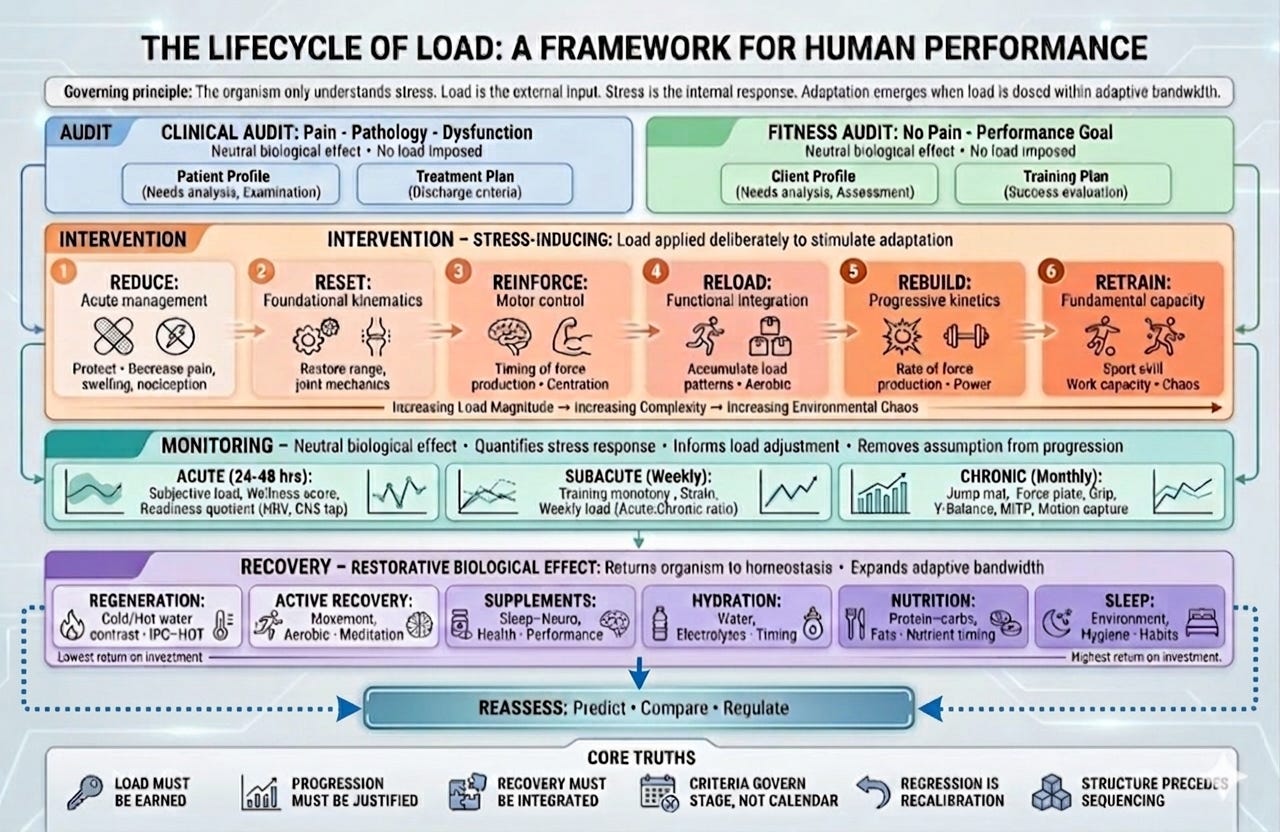
And then the loop returns to the Audit Elements — because after a cycle of intervention, monitoring, and recovery, the organism is in a different position than it was at the start. Its capacity has changed. Its tolerance windows have shifted. The audit confirms the new position, and the cycle continues — load sequenced progressively, monitored continuously, and regulated by deliberate recovery until the clinical or performance goal is reached.
This is not a theoretical construct. It is the practical logic that every successful rehabilitation and performance outcome already follows, whether the clinician is aware of it or not. The Language of Human Performance framework makes that logic explicit, reproducible, and teachable — because outcomes that cannot be explained cannot be replicated, and outcomes that cannot be replicated are not a system.
Five principles govern every pass through the loop:
Load must be earned. No load without audit.
Progression must be justified. No advancement without monitoring confirmation.
Recovery must be integrated. Not administered at the end — embedded throughout.
Criteria govern stage, not calendar. The organism advances when it is ready, not when the schedule permits.
Regression is recalibration. When the observed response exceeds predicted tolerance, stepping back is not a failure. It is the system working correctly.
Structure Precedes Sequencing
The lifecycle of load is not a new idea. Every practitioner working in rehabilitation or performance is already operating within it — consciously or not. The question is not whether load governs outcomes. It does. The question is whether the clinician is governing load deliberately — with a structured framework that makes every decision traceable and every progression justifiable.
When load is the governing variable — not one consideration among many, but the organizing principle around which every other clinical decision is made — outcomes stabilize. Recurrence rates decline. Discharge is based on demonstrated capacity rather than symptom resolution. Return to activity is earned rather than assumed. And the gap between rehabilitation and performance narrows, because both domains are finally speaking the same language.
Summary
The Language of Human Performance is load. And this is how it works in the model.
The Audit Elements are the entry point into the lifecycle of load and the non-negotiable first step before any demand is placed on the organism. Whether operating through the Clinical Audit Process or the Fitness Audit Process, the audit establishes where the organism currently sits relative to load tolerance before anything else happens. It profiles the individual, identifies constraints, organizes the clinician’s thinking around the appropriate entry point, and produces a plan with defined criteria for progression and discharge. The Audit Elements have a neutral biological effect — they do not impose load. Their purpose is to ensure that every load decision that follows is built on evidence rather than assumption.
The Intervention Elements are where load is applied — deliberately, sequentially, and in direct service of a specific adaptive goal. Organized across six stages of care on the rehabilitation and loading continuum, they move the organism progressively from protection to performance: from Acute Management, through Foundational Kinematics, Motor Control, Functional Integration, and Progressive Kinetics, to Fundamental Capacity. Each stage has defined priorities, specific interventions ranked by their theoretical load score, and explicit exit criteria that must be satisfied before advancement. The Intervention Elements are stress-inducing by design — they are not passive, and they are not interchangeable. They are load exposures, sequenced deliberately to move the organism forward without exceeding its current adaptive bandwidth.
The Monitoring Elements run continuously in parallel with the active stages of care, quantifying the organism’s stress response across three time horizons — acute variables in the 24 to 48-hour window, subacute variables across the week, and chronic variables across the month — to ensure that the load being applied is producing the expected biological response. They have a neutral biological effect, imposing no stress of their own, but they are the mechanism that keeps the entire system honest. Before load is applied, an expected response is defined. After load is applied, the observed response is compared to that prediction. When the response falls within the predicted window, progression is confirmed. When it exceeds predicted tolerance, the system regulates — adjusting load, modifying volume or complexity, extending recovery, or temporarily regressing before escalation resumes. Without monitoring, load is invisible. And when load is invisible, progression becomes reckless.
The Recovery Elements are the final and most consequential phase of the lifecycle — because they determine whether the stress imposed by load becomes adaptation or accumulation. Organized from lowest to highest return on investment across regeneration strategies, active recovery, supplementation, hydration, nutrition, and sleep, the Recovery Elements restore the organism toward homeostasis between loading exposures, expanding the adaptive bandwidth within which future load can be tolerated and converted into capacity. They are not optional components appended to an otherwise complete program — they are the biological mechanism through which every other element of the system produces its intended result. The load creates the stimulus. Recovery determines the outcome. Without the Recovery Elements, the lifecycle of load is incomplete.
Of the four phases of the lifecycle — audit, intervention, monitoring, and recovery — which one is most consistently underweighted in your current practice?
Most clinicians are reasonably strong in one or two domains. Very few are governing all four with equal deliberateness. And in almost every case of recurrence, stalled progress, or premature return to activity, the breakdown can be traced back to a gap in one of these phases — a step that was assumed rather than verified, a progression that was calendar-driven rather than criteria-based, a recovery strategy that was recommended rather than integrated.
If this framework is clarifying where that gap is in your practice, I would like to hear about it in the comments. And if you are already applying a load-based system and have found ways to make the monitoring and recovery phases more practical in a real clinical environment — that conversation is worth having here.