

The Intervention Elements: Where the Work Happens in the Periodic Table of Human Performance
After audits set the start, interventions drive adaptation across the continuum

In my last post, I discussed the audit elements and their relationship to the periodic table of performance elements in my Human Performance Model. As a reminder, the audit elements are the entry point into the model and provide a standardized process to check our work. They ensure everyone is working from the same playbook and make the model reproducible across practitioners. Once a patient or athlete has entered the system, we need a logical way to do the work. That’s where the next part of the periodic table — the intervention elements — comes into play.
Intervention Elements
The intervention elements are where we actually perform the work. We use load during rehabilitation or performance training to restore or improve function. These elements are the specific tools or methods aligned to the six stages of care on the rehabilitation (loading) continuum — the stages an individual passes through when moving from the treatment table back to the playing field: acute management, foundational kinematics, motor control, functional integration, progressive kinetics, and fundamental capacity. Remember, intervention elements have a negative effect on physiology — they increase the intensity of the stress response.
Acute Management
The first stage is acute management. Priorities here are protecting the tissue or joint from further injury and reducing pain and inflammation. This is the entry point for patients seeking rehabilitation. We use low-threshold graded exposure in a highly controlled environment to decrease tissue sensitivity, reduce excessive swelling, and delay muscle atrophy. Interventions may include patient education, functional nutrition, diaphragmatic breathing, static taping, dynamic taping, low-level laser, dry needling, electrical stimulation, vibration/percussion, diathermy, and acoustic wave therapy.

Foundational Kinematics
The second stage is foundational kinematics. Priorities are resetting range and direction of motion. We use moderate-threshold graded exposure in a moderately controlled environment to reset joint motion, increase afferent input to the CNS, enhance connective tissue repair, improve tissue sliding/gliding, and prevent contracture. Interventions may include myofascial decompression, compression flossing, direction-specific movement, nerve flossing, joint mobilization, joint manipulation, peripheral nerve entrapment work, manual therapy, and instrument-assisted soft tissue mobilization.

Motor Control
The third stage is motor control. Priorities are reinforcing the progression and timing of force production. Where foundational kinematics focuses on mobility, motor control restores stability. We use high-threshold exposure to stimuli in a low-control environment, promoting joint centration, improving length–tension relationships, and using isolated contractions to drive efferent output from the CNS. Interventions may include positional isometrics, developmental and positional stabilization, PAILS/RAILS, end-range loading, combined loading, eccentric loading, and blood flow restriction.

Functional Integration
The fourth stage is functional integration. Priorities are reloading tissue with weight-bearing exercise and accumulating load by increasing the magnitude of force production. This is also the entry point for athletes without pain who want to improve sport-related physical qualities. We use low-threshold progressive overload in a low-chaos environment. Here we reload fundamental movement patterns, improve aerobic endurance, increase reactive strength, and enhance general physical preparation. Interventions include aerobic endurance work and progressions/regressions of resistance training for the lower body, trunk/spine, and upper body.

Progressive Kinetics
The fifth stage is progressive kinetics. Priorities are rebuilding intensification and rate of force development (RFD) by stimulating fast-twitch fibers, shifting the force–velocity curve, improving the stretch–shortening cycle, and enhancing special physical preparation. We use moderate-threshold progressive overload in a moderate-chaos environment. Interventions may include explosive power, recycling power, sprinting, jumping, throwing, and, when appropriate, Olympic lifting.

Fundamental Capacity
The sixth and final stage is fundamental capacity. Priorities are retraining sport-related skill and the duration of force production. We use high-threshold progressive overload in a highly chaotic environment. The aims are to improve reaction time and agility with change of direction, retrain motor skill, and build work capacity, enhancing special developmental preparation. Interventions include reaction drills, agility and change-of-direction drills, motor skill acquisition work for techniques and tactics of sport, and specific work-capacity/conditioning. This is the realization of all necessary physical qualities for return to play after pathology or injury — or to excel in a chosen sport.

Practical Application
The intervention elements are how we execute work across the stages of care in the rehabilitation and loading continuum. In truth, we could call these stages the loading continuum, since loading interventions are used to elicit specific physiological responses. Whether the entry point is acute management for rehabilitation or functional integration for performance training, the intervention elements cover the full range of interactions with the individual. This post isn’t about arguing which interventions are “best” or detailing every application — that’s for another time. The focus here is the organizational structure and its progressive nature.
First, the organization: intervention elements are distributed across the stages of care — whether moving from injury on the table to competition, or building the physical qualities required for performance. The stages are intentionally ordered so specific qualities develop at the right time and according to individual tolerances. You have to master one stage before moving to the next because the qualities compound on one another.
Second, the team: these stages and interventions leverage all members of the integrated support team. During acute management, the medical team and/or athletic training staff lead. Through foundational kinematics and motor control, movement professionals — chiropractors or physical therapists, depending on the setting — take the lead. During functional integration and progressive kinetics, strength and conditioning drives the process. In fundamental capacity, sport coaches steer direction. Following the organization of the intervention elements creates a truly interdisciplinary model with the athlete at the center of care.
Third, progression: like the chemistry periodic table, these elements trend from least load to most load as you move top-to-bottom and left-to-right. You can see that when you look at the elements as a unit in our periodic table:
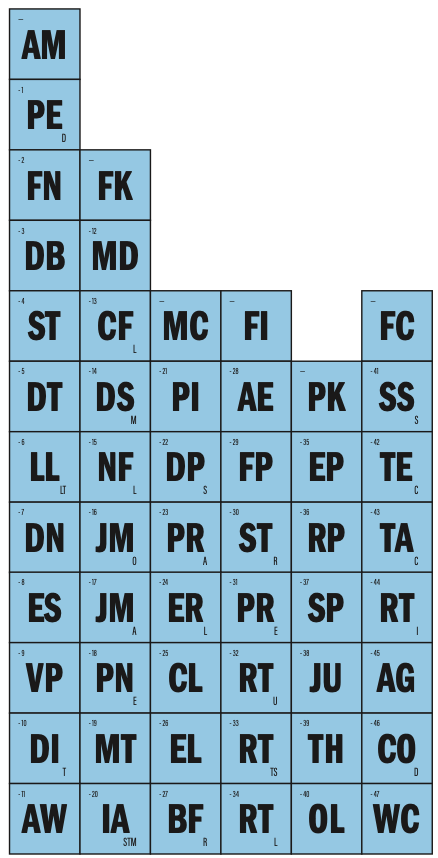
If physiology governs the organism, then progressively greater load is required at each stage to drive long-term adaptation. Responses will vary by person, but viewing the model through the lens of load makes it clear that progressive overload is essential for reaching peak potential. The takeaway from the intervention elements is simple: load matters, and we must find progressive ways to use more — at the right time — to restore and improve function.
The audit elements place us at the right starting point in the model; the intervention elements are where we do the work. To be effective, that work must follow a specific order of operations and keep load at the center. Considering load with each intervention helps us choose the right tool to meet the goal while favoring the lowest systems load that achieves the objective. The intervention elements form the foundation of the periodic table of performance elements and provide the systematic framework for achieving peak physical potential within the human performance model. Now that we’ve covered the audit and intervention elements, we can move on to a discussion of the monitoring elements.
With two sections of the periodic table complete, are you starting to see how it will work as a whole? What questions do you have at this point? Leave a comment below.