

What The Periodic Table Taught Me About Human Performance
How a governing framework finally gave load, intervention, monitoring, and recovery a shared grammar

In 1869, Dmitri Mendeleev did something no one had done before. He didn’t just list the elements he knew about. He arranged them by atomic weight, by shared properties, and by predictable behavior. In doing so, he revealed gaps — not because his table was incomplete, but because the elements that belonged in those gaps had not yet been discovered. The structure told him they existed, and told him exactly what properties they would have when they were found.
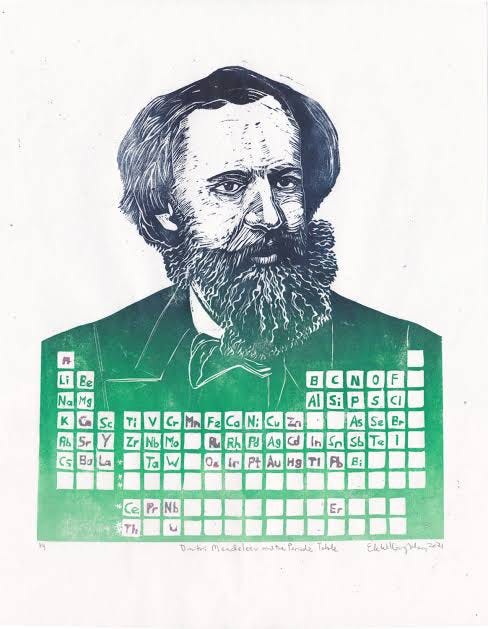
Three of those elements were confirmed within fifteen years. Exactly where he said they would be. That is the power of a governing framework: it doesn’t just organize what you know. It makes visible what you haven’t found yet. Human performance has never had that structure. So I decided to create one.
The problem nobody was talking about
Every field in health and performance — physical therapy, strength and conditioning, sports medicine, rehabilitation — operates with its own language, its own tools, and its own protocols. A patient moves through a rehab clinic to a performance facility, and at each stop a new framework takes over. A new vocabulary, new priorities, a new logic. At every handoff, the incoming team is essentially starting from scratch, because the documentation from the previous provider does not map onto their vocabulary, tools, or clinical logic.
Nobody is negligent. Nobody is working against the patient. But the system produces fragmented care because there is no common structure underneath it. There is no organizing principle that travels with the person from acute pain back to the field. The problem is not that practitioners lack knowledge. The problem is that there is no shared grammar for applying it.
I have spent years watching skilled practitioners work in isolation from each other — not because they don’t want to collaborate, but because they literally do not share a structural language that makes collaboration coherent. That is what the Periodic Table of Performance Elements was built to fix.
Load is the language. The table is the grammar.
Here is the foundational premise of the entire framework: the organism only understands stress. Every stimulus — physical, mechanical, metabolic, neurological, or psychological — registers as load. Every practitioner in every discipline is ultimately working with load, whether they call it that or not.
A surgeon managing post-op inflammation is managing load. An athletic trainer performing cold laser therapy is managing load. A chiropractor performing soft tissue mobilization is applying load. A physical therapist prescribing isometric exercises is applying load. A strength coach programming a squat is applying load.
Load is the word every organism speaks. It is the universal variable underneath every clinical and performance decision. But vocabulary alone is not enough. You can know every word in the English language and still produce nonsense if you don’t understand the grammar. Grammar governs how variables relate to each other, in what order they should appear, and what happens when that order is violated. The Periodic Table of Performance Elements is the technical expression of load as the language of human performance.
The four domains
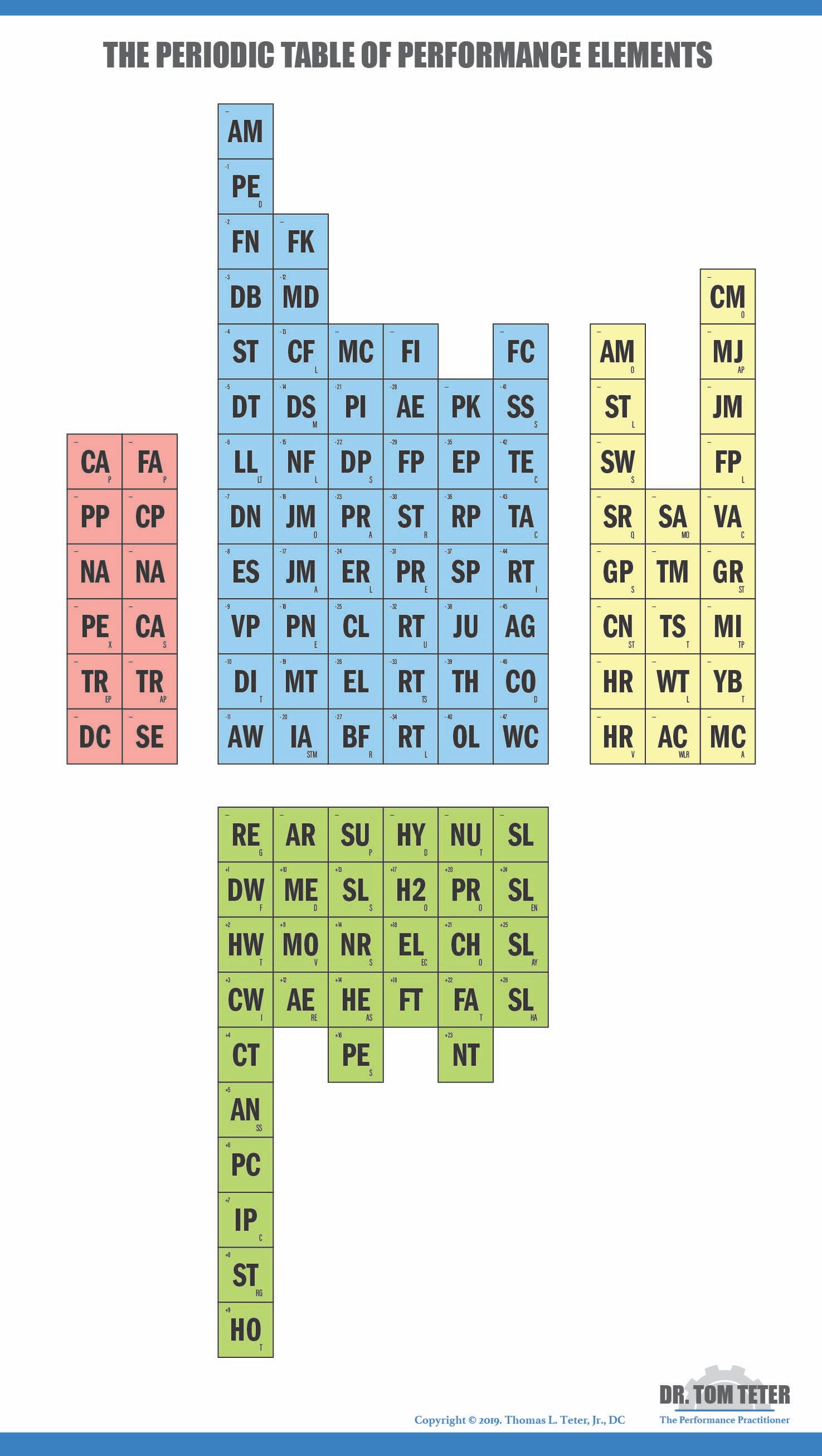
The Periodic Table of Performance Elements organizes every clinical and performance variable into four domains. Each domain reflects a distinct biological role in the lifecycle of load. Together they form a closed-loop system — a unified operating system for clinical decision-making that creates checks and balances to ensure you do not skip steps, and that you have constant feedback on how load is being received by the individual.
The Audit Elements are intentionally neutral — they impose no biological stress on the organism. They exist for one purpose: to answer the question, what can this organism tolerate? Constraints must be mapped and performance demands must be identified. The Audit Elements are the correct entry point into the system so that intervention progressions can be established. Without audit, load becomes assumption. And assumption is the origin of the most preventable injuries and setbacks in clinical and performance practice.
The Intervention Elements are stress-inducing by design. This is where load is applied — deliberately, sequentially, and at a stage-appropriate magnitude within the capacity profile the audit revealed. Intervention is not a fixed set of treatments or exercises. It is a progression. What is available to the practitioner at any moment depends entirely on where the organism currently sits on the loading continuum. Intervention without audit is a prescription written without a diagnosis.
The Monitoring Elements are again neutral to the organism. They do not add load — they read the organism’s response to load that has already been applied. Monitoring operates across three time horizons: acute (what happened in response to this session), subacute (what trends are emerging across this week), and chronic (what cumulative load exposure has produced over the course of a month). Without monitoring, load is invisible. The practitioner is making the next decision based on no information.
The Recovery Elements are restorative in nature, and this is the most consistently misunderstood domain in the entire framework — both in how it is conceptualized and how it is prioritized. Recovery is not the absence of training. It is not passive, and it is not simply the removal of fatigue. Recovery reconstitutes the organism’s adaptive capacity: its ability to benefit from the next load exposure, not merely tolerate it. If recovery is inadequate, load accumulates faster than it is processed. Adaptation stalls and tolerance decreases. The practitioner who increases intervention in response to stalled adaptation is adding demand to a system that cannot process the demand it already has.
A closed-loop system, not a checklist
When these four domains are viewed together, they do not form a list. They form a closed-loop system. The audit determines what load is appropriate before any is applied. The intervention applies that load deliberately and progressively. The monitoring reveals how the organism is responding. The recovery restores the capacity to receive the next exposure. Then the loop repeats. Monitoring data informs the next audit. The next audit recalibrates the next intervention. Recovery is matched to the stress signature the monitoring revealed.
Structure always precedes sequencing. That is the rule the table makes operational. Before deciding what comes next, the organism’s current position relative to load tolerance must be understood. Without that principle, sequencing is reactive. With it, predictable and preventable failures become visible before they happen.
One framework along the full continuum
Here is what I want every practitioner reading this to understand clearly: a post-operative patient and an elite athlete are not in different systems. They are both operating under the same biological rules. The same four domains govern both. What changes is magnitude. What changes is tolerance. What changes is time horizon. The framework does not change, and the table holds.
This is why the Periodic Table of Performance Elements is not a tool for any single discipline. It is a cross-domain framework that gives every practitioner — regardless of setting, certification, or patient population — a shared structural reference point. A chiropractor, PT, strength coach, and sports medicine physician can all be working with the same person. With the table, they are working from the same structure. Handoffs are coherent, decisions are traceable, and care does not restart from scratch at every transition.
What this changes in practice
The Periodic Table of Performance Elements does not ask you to abandon your tools, your certifications, or your clinical judgment. It gives all of those things a governing structure.
In practical terms, this means:
Every assessment has a biological rationale, not just a clinical habit.
Every intervention is stage-appropriate — not because the protocol says so, but because the audit confirmed it.
Every monitoring decision is anchored to a time horizon — acute, subacute, or chronic — so the right question is being asked at the right moment.
Every recovery prescription is matched to the stress signature the monitoring revealed, not to a general guideline.
Without the table, every intervention defaults to preference. With the table, every intervention defaults to logic. This is not a small distinction. This is the difference between a field that fragments and a field that coheres.
The table that was missing
Mendeleev’s periodic table didn’t just organize chemistry. It gave chemists a structure that made the known predictable and the unknown locatable. When gaps appeared in the table, they weren’t failures. They were questions the table was already answering. The missing elements were already implied by the structure.
The Periodic Table of Performance Elements works the same way. It does not just organize what we already know about human performance. It gives practitioners a structure that makes the next decision visible — and makes the next gap in our knowledge visible too. Every field develops its vocabulary over time. Now the Language of Human Performance has its grammar.
I wrote the first draft of this concept on a torn piece of paper at 3:00 AM in 2017. That version was a modified intervention elements framework — a way to organize my thinking around the stages of care during rehabilitation and the specific interventions I was using within each stage. In 2018, it struck me not just to organize stages of care horizontally, but to rank each intervention within a vertical category based on its theoretical load. The first formal version was presented in continuing education coursework in 2019, and again at a conference in 2020.
In 2021, I expanded the table to include the Audit Elements — a way to demonstrate how to enter the model and determine tolerances and constraints before applying load as intervention. After presenting the concept in 2022, I realized how incomplete the model still was. If you have a way to audit tolerance and a way to apply load through intervention, you need a way to quantify those loads to confirm they are being accepted. That is when I added the Monitoring Elements. The Recovery Elements followed in 2024, to ensure the framework included a mechanism for restoring homeostasis during rehabilitation and training.
The current version of the Periodic Table of Performance Elements was finalized in 2025. As you can see, it has gone through at least four or five distinct evolutions. The entire purpose of the table is to provide an organizing structure that centers load as the language and creates a governance for collaboration across rehabilitation and human performance.
In all my years as a clinician and as a strength coach, the thing that was always missing was the governing structure. I could never find a framework that allowed everyone to operate using the same language and that encompassed everything many of us were doing under the banner of human performance. So, just like Mendeleev, I created one — using his periodic table as a guide.
Every variable now has a home. Every decision has a logic. I am sure this version of the table will continue to evolve, but I am excited to put it out to the world and hear whether other practitioners see the model the same way I do.
Does your current clinical or coaching practice have a governing framework — something that tells you not just what to do, but in what order and why? Where does your process break down when a patient transitions from your care to someone else’s?
I’d like to hear how other practitioners are thinking about the handoff problem in the comments.