


Recently, I came across a social media post by an internationally recognized chiropractor and strength coach who claimed, “Exercise is a skill, and in order to succeed in rehabilitation and fitness, you need to be good at it.” What I believe he intended to convey is that exercise is a motor skill—that coaching the motor skill execution of specific exercises is central to success in both rehab and training.
I don’t entirely disagree with that. As performance practitioners, we must be able to prescribe the correct exercise and coach our patients or athletes through its execution. Execution is how we load a motor pattern, and it’s critical that we do so with precision. However, exercise is more than just a skill that needs coaching. That post gives us a good opportunity to explore the broader question: What is exercise, really?
Exercise Defined
Exercise is often defined as a physical activity performed to improve health or function, typically involving repetitive movement. While accurate, this definition doesn’t capture its full essence.
In reality, exercise is the process of applying force to a motor pattern with the intent to elicit a specific physiological adaptation. It is how we stimulate an organism’s internal ecosystems to produce long-term change. And in order to achieve this change, the stimulus must be specific to the desired adaptation. This is the essence of specific adaptation to imposed demands (SAID).
Put simply: exercise = stimulation → adaptation.
The Formula of Exercise
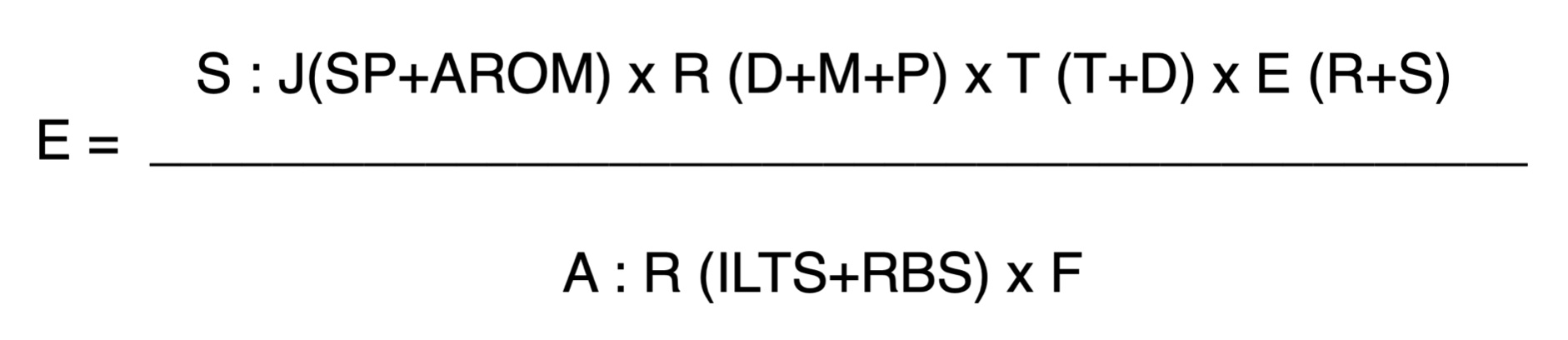
If we accept that exercise is the application of stimulation to a motor pattern for the purpose of adaptation, then we must have a formula that governs its use. Too often, exercise is reduced to “something someone does,” without understanding its essential components. Here’s the formula I use to break it down:
Breaking Down Exercise: The Stimulation Side
Let’s start with the stimulation. This is the numerator in our formula.

It includes:
(J) Joints – including their
(SP) Starting Position
(AROM) Active Range of Motion
(R) Resistance – including its
(D) Direction
(M) Magnitude
(P) Placement
(T) Time – including
(T) Tempo
(D) Duration
(E) Effort – including
(R) Repetitions
(S) Sets
This formula forces us to consider biomechanics, not just coaching cues. It asks us to look beyond whether someone can perform a motor pattern, and instead consider the quality and conditions under which it’s executed.
Take the joints, for instance. A person’s starting position and active range of motion through a given motor pattern — say, a squat — are indeed what the influencer was referring to when talking about exercise as a skill. That’s not wrong, but it’s a limited view. There’s more to effective training than just moving through a pattern correctly.
Let’s use a squat to illustrate.
First, we must assess whether the person can even perform the pattern under load. Can they maintain control and alignment under gravity while keeping their center of mass over their base of support without compensation? If not — or if it causes pain — they likely have a movement dysfunction that needs to be evaluated.
If they can perform the movement, then coaching comes into play. This is where cueing and feedback refine the motor pattern. But again, this is only one piece of the puzzle.
We must also:
Choose the appropriate form of resistance
Quantify how much resistance
Consider the direction and placement of that load
Placement, for example, impacts joint moment arms and can increase or decrease joint forces based on positioning relative to gravity.
Time and Effort Matter
Time in this equation refers to both tempo and duration. The relationship between time and load directly influences the adaptation we get. For example:
A heavy load moved slowly for short duration → maximal strength
A moderate load moved quickly for moderate duration → rate of force development
Time and load together dictate the stimulus, and therefore, the outcome.
Effort, too, is multifactorial. It’s influenced by:
Magnitude of resistance
Number of repetitions
Number of sets
Perceived exertion
Effort determines the intensity, which ultimately drives the disturbance in homeostasis needed for adaptation under the General Adaptation Syndrome model.
Breaking Down Exercise: The Adaptation Side
Now let’s look at the denominator in the equation.
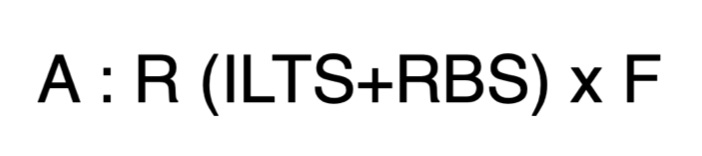
Adaptation (A). Adaptation is governed by Recovery (R).
Recovery includes:
ILTS – Intensity of the Last Training Session
RBS – Rest Between Sessions
Frequency – How often sessions occur
Though recovery is highly nuanced, these three factors give us a working model for how the body returns to homeostasis. Without adequate recovery, adaptation won’t happen — or worse, negative adaptation (e.g., overtraining) could occur.
Recovery is affected by things like health, sleep, nutrition, hydration, supplementation, and active recovery techniques. We’ve explored these factors previously when discussing readiness and load management.
Why Does This Matter?
Returning to the influencer’s post: yes, exercise is a skill, and skillful execution is important. But exercise skill is only one part of a much broader equation.
Success in rehab or fitness isn’t just about coaching movement. It’s about:
Selecting the right exercise
Progressing it appropriately
Tailoring resistance, time, and effort to match the desired adaptation
Ensuring recovery is adequate for positive adaptation
To truly drive results, we must take a global view of exercise — not as a set of discrete reps and sets — but as a biomechanical, physiological, and recovery-driven process.
In my opinion, success in rehab or fitness programming depends on prescribing the right exercise, with the right progression, for the right person, at the right time. It also requires manipulating variables with precision to stimulate tissues and achieve the adaptation necessary for life and sport. Simplified sound bites and infographics may be trendy, but they miss the depth this process demands.
I’m not writing this to dismiss another professional’s viewpoint — but to expand the conversation. If we want better outcomes for our patients and athletes, we need to elevate the dialogue around exercise. That starts by understanding what it truly is.
What’s one variable in the exercise equation you think clinicians overlook the most — and why does it matter?
Hey Dr. Teter, I totally agree with your explanation of exercise, but there is another issue. Think about this, we have so much knowledge about how to mechanically do the exercises, how to hydrate and rest during the exercise, and then how to recover better. There is no doubt that the knowledge is unlimited and filled with peer reviewed studies to back them up. So with so much knowledge why aren't more people physically in-shape? What people are missing is their desire to exercise. We can send our patients to the best trainer in the world, but if that person hates working out, the person will not sustain the exerciwse regimen necessary to accomplish their goals.
I think we need to be teaching people how strength training and flexibility will improve their aging process. My focus is on flexibility and when I teach people how their muscles can help improve the mobility, improve joint movement, and spine health leading them to better aging and reducing their risk of disease. I teach them how strength training allows them to stand up, walk, run, and lift whatever they want purely from increasing their strength. I also teach them how improved flexibility lubricates thie joint and discs to improve their range of motion and get the optimum use of their muscles. The key is learning how to stretch correctly. 90% of people stretching today will never reach their goals of flexibility because static stretching is more strength training then flexibility training. The key reason is we do not work with the emotional side of muscles and the nrevous system and this slows their progress. Love to talk more with you about it.