

Stop Confusing Tissue Tolerance with Tissue Capacity
The Distinction That Determines Whether Your Patient Is Actually Ready

There is a distinction that the rehabilitation and performance fields have been blurring for decades. It has been happening quietly, consistently, and at significant cost to the people in our care. It is the distinction between tissue tolerance and tissue capacity. On the surface, these two concepts seem close enough to use interchangeably. In practice, confusing them is one of the most consequential errors a clinician or coach can make. It determines how we define readiness. It determines when we return someone to full activity. And it determines whether the injury we just treated comes back six weeks later.
The Language of Human Performance framework was built, in part, to name this distinction clearly and give practitioners the tools to act on it. This post is about why that distinction matters — and what it costs us when we ignore it.
What Tissue Tolerance Actually Means
Tissue tolerance refers to the threshold at which a specific tissue — tendon, ligament, muscle, or bone — will fail under load. It is the structural breaking point. When load exceeds what the tissue can accept at that moment, breakdown occurs. This is what we measure when we screen for pain, swelling, end-range discomfort, and the classic clinical signs of tissue stress. It is a real variable, it is clinically important, and it is not the same thing as capacity.
Tissue tolerance is fundamentally a threshold concept. It answers a binary question: did the tissue hold, or did it fail? That question has value in acute clinical assessment. It tells you where the tissue currently sits on a stress curve. What it does not tell you is whether the organism can meet the sustained, cumulative, and variable demands of the environment it is about to return to.
This is where we get into trouble. We have built an enormous amount of clinical infrastructure around measuring tolerance — pain scales, orthopedic tests, strength symmetry ratios, range of motion benchmarks — and we have quietly allowed that infrastructure to stand in for something much larger:
We discharge when tolerance is restored.
We return athletes to play when the tissue has stopped signaling distress.
We progress training when the patient reports feeling ready.
All of this is built on tolerance. Almost none of it is built on capacity.
What Tissue Capacity Actually Means
Capacity is a continuum concept. It describes not just whether the organism can tolerate a single load event, but whether it can sustain, absorb, and recover from the full spectrum of demand it will face over time. The Language of Human Performance framework describes capacity across five distinct dimensions:
Mechanical capacity — the structural ability of tissue to accept and distribute load without failure
Metabolic readiness — whether the energetic resources are available to sustain repeated exposure to demand across a full session, a full week, or a full competitive season
Neurological coordination — whether the timing and sequencing of motor output holds under varying conditions of velocity and fatigue, as they actually exist in sport and in life — not in a controlled clinical test
Psychological stress tolerance — whether the organism can process cognitive and emotional load without compromising physical output; every high-stakes return, every competition, every demanding workday carries that load
Recovery capacity — whether the organism can reconstitute adaptive resources between exposures, because the real demand is not the single session but the accumulation of sessions over time
Notice that tissue tolerance maps primarily onto mechanical capacity — one dimension out of five. When a clinician clears a patient based on tissue tolerance alone, they are evaluating one-fifth of the organism’s operational readiness and making a return-to-activity decision as if it were complete.
Every one of the remaining four dimensions can be impaired while tissue tolerance is fully restored. Every one of them represents a gap between clinical clearance and actual readiness. That gap is where reinjury lives.
The Cost of Confusing the Two
When we conflate tolerance with capacity, we make decisions that look clinically sound but are biologically incomplete. The consequences operate on three levels.
Recurrent injury. The athlete returns to full training. The tissue was cleared. The structural markers were acceptable. Six weeks later, the same tissue fails again — or a different tissue fails under the compensatory load the first injury created. The treatment cycle restarts without ever examining whether the organism was actually prepared for what it was sent back to.
Underperformance. An organism operating at the tolerance threshold is technically cleared and structurally intact — but deficient in metabolic readiness, neurological coordination, or recovery capacity will underperform relative to its prior baseline. The clinician sees a training problem. The coach sees a motivation problem. The athlete feels a confidence problem. It is actually a capacity problem that was never identified because the discharge criteria only measured tolerance.
Capacity mismatch. The most significant cost is the systematic gap between what the organism can currently do and what the environment will ask it to do. The Language of Human Performance framework defines this as the capacity mismatch — the governing condition in injury production. The injury is the signal. The mismatch is the cause. Treating the injury without resolving the mismatch guarantees that the cause remains active. The output will recur — different tissue, different mechanism, same underlying problem.
The Relationship to Rehabilitation
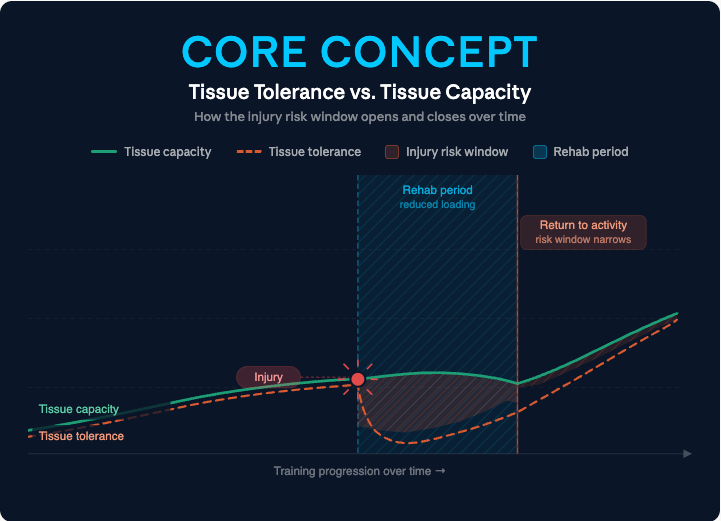
Rehabilitation, properly understood, is not a tolerance restoration process. It is a capacity restoration process. The two are related — you cannot build capacity on a tissue that cannot tolerate load — but tolerance is the floor, not the ceiling. A rehabilitation program that terminates at the tolerance floor has not completed its job. It has completed the first phase of a much larger process and labeled it finished.
The Language of Human Performance framework organizes rehabilitation across six stages of care, each defined by specific criteria that must be verified before progression occurs. The return-to-activity decision is not made when pain resolves or when strength symmetry reaches a benchmark. It is made when the full capacity profile has been evaluated against the specific demands the organism is returning to.
This reframe changes what rehabilitation looks like structurally:
Discharge is not an endpoint — it is a transition from supervised care to the next phase of governed loading.
The clinician’s role extends beyond tissue management into the broader question of organism readiness.
The criteria for return-to-activity must be defined not by what the tissue can tolerate in a clinical environment, but by what the organism will actually face when that environment is removed.
Consider what tolerance-based clearance actually confirms — and what it does not:
Pain-free movement confirms basic tissue healing and tolerance to mild-to-moderate load. It does not confirm tolerance to integrated sport demand.
Symmetrical range of motion confirms that range has been restored. It does not confirm that the system can perform at speed under compressive load.
A passed strength test confirms isolated force production capacity. It does not confirm sustained output across repeated efforts, rate of force development under millisecond time constraints, or the ability to maintain that output at the end of a third consecutive high-demand day.
The Relationship to Performance
On the performance side, the tolerance-capacity confusion manifests differently but produces the same downstream errors.
Performance programs are built around adaptation — the deliberate application of load in excess of current tolerance, followed by recovery, followed by an upward shift in capacity. That is the biological mechanism of improvement. And it works, right up until load exceeds not just tissue tolerance but the full capacity profile — including the metabolic and recovery dimensions that most training programs do not formally monitor.
Overtraining, overuse injury, and unexplained performance decline are often framed as problems of too much load. They are more precisely problems of insufficient capacity relative to the load being applied:
The organism’s mechanical tolerance may still be intact.
The metabolic tank is depleted.
Recovery between sessions is incomplete.
Neurological coordination under fatigue is degraded.
The organism is operating in a capacity deficit, and the training program continues to apply load. The result is not a tolerance failure — it is a capacity collapse.
The Language of Human Performance framework governs this through systematic monitoring of the full capacity profile across sessions — not just tissue response. When monitoring data indicates that one or more dimensions of capacity is failing to reconstitute between exposures, the response is loop recalibration: load is adjusted, monitoring frequency is increased, recovery emphasis is intensified, and return to prior parameters is confirmation-based rather than time-based.
This is the distinction between a training program and a governed system. A program applies load according to a plan. A governed system applies load according to the organism’s verified current state. The first is a schedule. The second is a language — one the organism is constantly speaking through its readiness markers, and that the clinician or coach must be equipped to read.
Tolerance vs. Capacity: The Clinical Summary
It is worth stating the core distinction plainly, because these two concepts are fundamental to clinical reasoning and are routinely conflated:
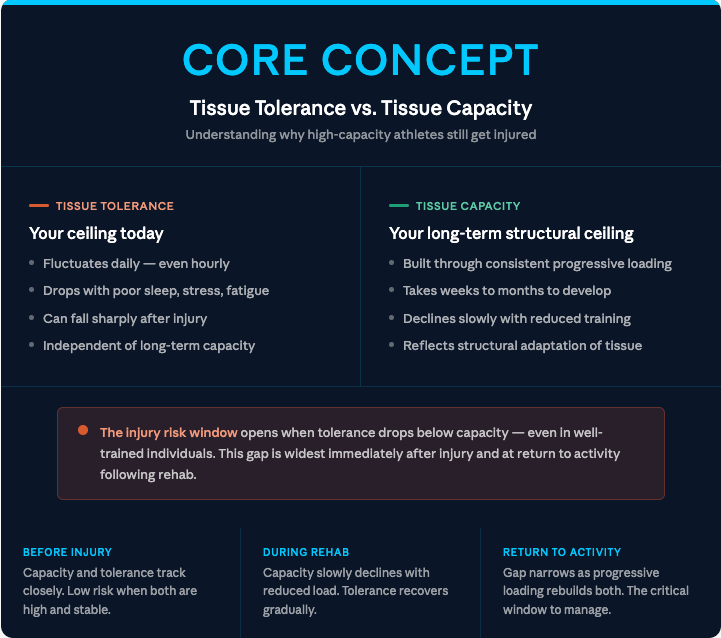
Tissue tolerance is the maximal load a tissue can handle at a given moment — the current threshold before damage or failure occurs. It is moment-to-moment, changes with acute stress, and its clinical relevance is injury risk right now.
Tissue capacity is the tissue’s trained, adapted ability to handle load over time — what it is capable of sustaining repeatedly when properly conditioned. It is built through progressive loading, reflects structural adaptation, and changes over weeks and months of training and recovery. Its clinical relevance is resilience over time.
In most cases, rehabilitation only restores tolerance — enough to get out of pain. It does not rebuild capacity. This is the core argument for progressive loading in rehabilitation rather than symptom management alone.
What Needs to Change
The practical implication of everything above is a change in how we define the endpoints of our work.
In rehabilitation, the question is not: Has the tissue healed? It is: Is the organism ready for the demands ahead?
In performance, the question is not: Can the tissue tolerate today’s training load? It is: Does the organism have sufficient capacity across all five dimensions to absorb today’s load and reconstitute before the next exposure?
These questions require different tools, different criteria, and a different framework for decision-making than the tolerance-focused model that currently dominates both fields. They require a governing system — one that moves load decisions from the schedule and places them where they belong: in the hands of real-time data about the organism’s actual readiness state.
Tissue tolerance is part of the picture. Tissue capacity is the whole of it. Until we treat them as distinct variables — each requiring its own assessment, its own monitoring, and its own criteria for advancement — we will continue to see the same injuries, the same recurrences, and the same gap between clinical clearance and actual readiness that has defined this field for too long.
The organism is not ready when the injury is resolved. The organism is ready when capacity meets the required demands — and that readiness has been verified.
From a clinical and performance perspective, that distinction is worth making. And worth building a practice around.
Here is the question I want to leave you with:
When you last cleared a patient for return to activity — which of the five capacity dimensions did your discharge criteria actually measure?
If the honest answer is one — mechanical capacity, because pain had resolved and strength symmetry looked acceptable — that is not a clinical failure. It is a structural one. The criteria most of us were trained to use were built around tolerance. They were never designed to verify capacity.
If this distinction is changing how you think about a current patient or a recent discharge decision, I would like to hear about it in the comments. And if you are already using a capacity-based framework in your practice and have found a way to make it work in a real clinical environment — that conversation is equally worth having.